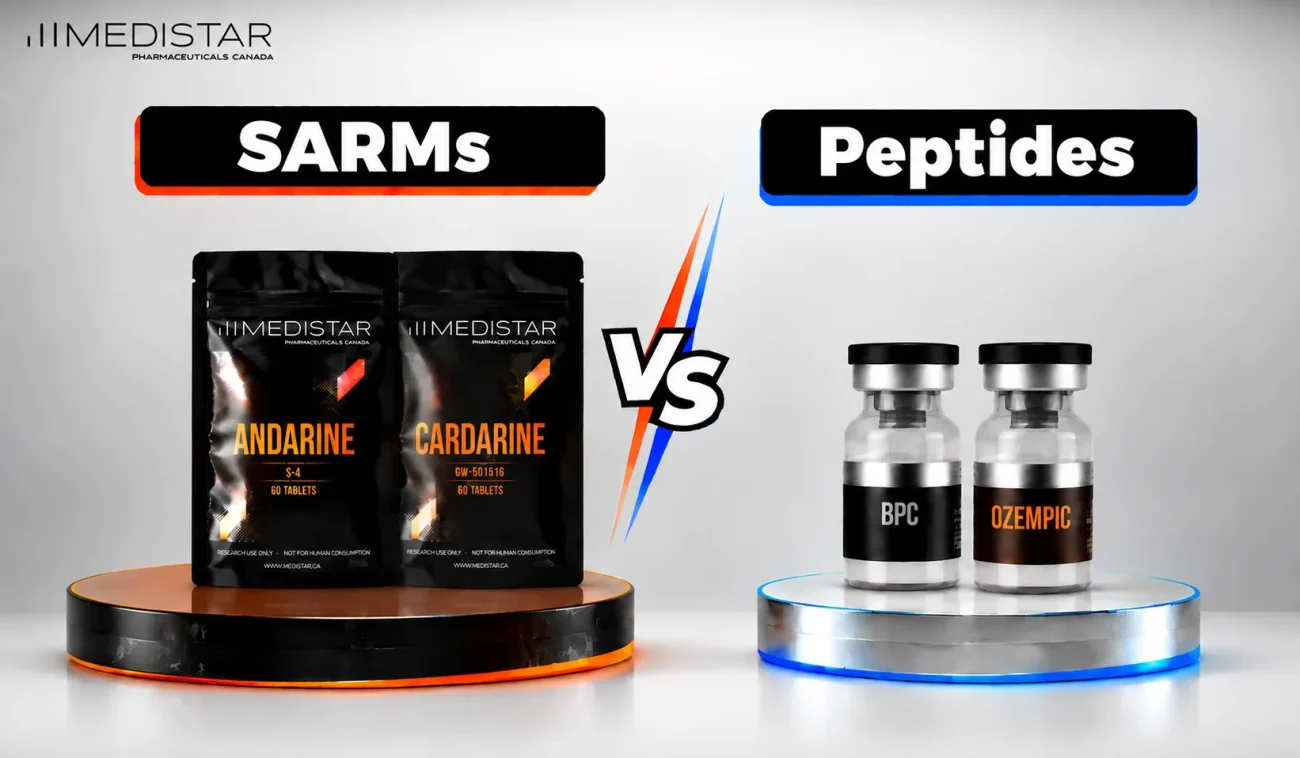
Athletes and fitness enthusiasts looking to enhance performance, build muscle, or improve recovery often compare two distinct compound categories: SARMs and peptides. Both have grown in popularity across the Canadian fitness community. Both are frequently misunderstood. Both carry distinct benefits, uses, and risks worth understanding before you decide.
This guide breaks down the SARMs vs peptides comparison in plain terms. We cover how each works, what they are best used for, and what you need to know about their risk profiles. If you’ve been asking which is better, the answer depends entirely on your goal.
Key Takeaways
- SARMs and peptides are fundamentally different compounds. They work through different biological pathways and serve different purposes.
- SARMs bind selectively to androgen receptors and are primarily used for muscle growth, strength, and cutting.
- Peptides are short amino acid chains that signal specific biological processes such as recovery, fat metabolism, and hormone release.
- SARMs carry a higher risk profile due to hormonal suppression. Post-cycle therapy is typically required after a SARMs cycle.
- Peptides are generally considered lower risk, though research into long-term effects remains limited.
- Neither SARMs nor peptides is universally better. The right choice depends on your goal, experience level, and risk tolerance.
- Product quality is critical for both. Medistar Canada provides lab-tested SARMs and peptides manufactured to verified pharmaceutical standards.
What are SARMs?
What Are SARMs? Selective Androgen Receptor Modulators are synthetic compounds designed to bind to androgen receptors in specific tissues, primarily muscle and bone, while minimizing interaction with other tissues such as the prostate or liver. This selectivity is what sets them apart from traditional anabolic steroids.
Common SARMs used include building lean muscle mass, increasing strength, improving body composition, and preserving muscle during a caloric deficit. SARMs for cutting are especially popular among users who want to reduce body fat without losing lean tissue.
Popular options include Ostarine (MK-2866), Ligandrol (LGD-4033), RAD-140, and Cardarine (GW-501516). Each has a distinct profile in terms of potency, half-life, and best application. SARMs for muscle growth are the most widely discussed use case, though applications in recovery and bone density are also well documented.
What are Peptides?
What are peptides? Peptides are short chains of amino acids that act as signaling molecules in the body. Unlike SARMs, they do not bind to androgen receptors. Instead, they trigger specific physiological responses by interacting with receptors relevant to their function, such as growth hormone secretagogue receptors or melanocortin receptors.
Common peptide uses include stimulating natural growth hormone release, accelerating tissue repair, supporting fat metabolism, and improving sleep quality. The distinction from SARMs is important: proteins vs peptides differ in chain length and function, but peptides used in performance contexts are specifically selected for their targeted signaling effects.
Well-known peptides in the fitness space include BPC-157 for injury recovery, TB-500 for tissue repair, CJC-1295 and Ipamorelin for growth hormone stimulation, and Melanotan for various metabolic effects. Peptides for recovery are among the most popular applications, particularly for athletes dealing with joint issues or soft tissue injuries.
SARMs vs Peptides: Benefits Compared
Here is a brief comparison of SARMs and Peptides:
SARMs Benefits
SARMs are designed to produce anabolic outcomes in muscle and bone while limiting activity in other tissues. Here is what makes them appealing to athletes and bodybuilders.
- Targeted muscle and strength gains without the full hormonal impact of anabolic steroids.
- Improved body composition, particularly relevant for cutting phases.
- Bone density support, which makes certain SARMs useful in recovery from injury.
- Relatively long half-lives, meaning once-daily dosing is typically sufficient.
Peptide Benefits
Peptides work by signaling the body to perform specific functions rather than directly introducing hormones. Their versatility and lower suppression risk make them suitable across a wide range of goals.
- Stimulate natural hormone release rather than introducing synthetic hormones directly.
- Strong recovery applications, particularly for connective tissue, tendons, and joints.
- Lower suppression risk compared to SARMs, as they do not interact with androgen receptors.
- Versatile applications across fat loss, recovery, sleep, and general wellbeing depending on the peptide selected.
The core distinction in SARMs benefits versus peptide benefits comes down to mechanism. SARMs directly influence androgen receptor activity. Peptides influence the body’s own signaling cascades without the same hormonal disruption.
SARMs vs Peptides: Risks Compared
Let us quickly look at a comparison of SARMs and Peptides:
SARMs Risks
SARMs carry a higher risk profile than peptides, mainly because they interact with androgen receptors. Understanding these risks before starting a cycle is essential.
- Hormonal suppression is the primary concern. Most SARMs suppress natural testosterone production to some degree. Post-cycle therapy is typically required after a cycle.
- Liver stress is lower than with oral anabolic steroids but not zero, particularly with longer cycles or higher doses.
- Long-term human safety data is limited. Most SARMs have not completed full clinical trials.
- Counterfeit and underdosed products are widespread in the unregulated market. Product quality directly affects both safety and results.
Peptide Risks
Peptides are generally considered lower risk than SARMs, but they still require consideration. Knowing the potential downsides helps you use them responsibly.
- Side effects are generally mild and dose-dependent. Injection site reactions and temporary water retention are most common.
- Some peptides that stimulate growth hormone release can affect blood sugar levels, which is relevant for users with metabolic concerns.
- Long-term human data is limited for many peptides, particularly newer compounds.
- As with SARMs, product quality is critical. Improperly manufactured or contaminated peptides carry infection and dosing risks.
Overall, SARMs risks are considered more significant than peptide risks primarily because of hormonal suppression. This does not make SARMs categorically unsafe. It means they require more careful protocol planning and post-cycle management.
Which Is Better for Your Goal?
The SARMs vs peptides question does not have a universal answer. The right compound depends on what you’re trying to achieve.
- For lean muscle growth and strength: SARMs are the more direct tool. Compounds like LGD-4033 and RAD-140 are specifically designed for anabolic outcomes.
- For recovery from injury: Peptides such as BPC-157 and TB-500 have a strong evidence base for tissue repair that SARMs do not replicate.
- For fat loss with muscle preservation: Both have applications here. SARMs like Cardarine and Ostarine are frequently used in cutting phases. Peptides like CJC-1295 support fat metabolism by stimulating growth hormone.
- For beginners: Peptides carry a lower risk profile and are a more forgiving entry point for those new to performance compounds.
- For experienced users: SARMs and peptides are often stacked to address multiple goals at once, with peptides supporting recovery while SARMs drive muscle and strength adaptations.
Why Product Quality Defines Your Results
Whether you choose SARMs, peptides, or both, the quality of what you purchase determines the safety and effectiveness of your protocol. The unregulated market for both categories is filled with underdosed, mislabeled, or contaminated products.
Medistar Canada manufactures SARMs and peptides to pharmaceutical-grade standards in certified Canadian facilities. We lab-test every product for concentration accuracy and sterility before it reaches the customer. When you buy steroids Canada-wide through Medistar Canada, you are purchasing from the manufacturer directly. That means no third-party markups, no repackaged imports, and no compromise on what’s actually in the product.
For Canadian athletes and fitness enthusiasts looking for verified SARMs and peptides, Medistar Canada offers the most transparent and quality-controlled option available. Products ship discreetly across Canada with fast delivery nationwide.
Final Thoughts
The SARMs vs peptides comparison is not about which is superior. It is about what fits your goal, experience level, and risk profile. SARMs offer direct anabolic effects with a higher hormonal risk. Peptides offer targeted signaling with a gentler safety profile.
Understanding the difference allows you to make a more informed decision, whether you choose one, the other, or both together. Whatever you decide, product quality most directly determines your outcome.
Medistar Canada manufactures both SARMs and peptides to verified pharmaceutical standards. For Canadian athletes who want lab-tested, accurately dosed products shipped discreetly nationwide, Medistar Canada is the most direct and transparent source available.
Disclaimer: This content is for informational purposes only and is not medical advice. Always consult a healthcare professional before using any steroids, SARMs, or supplements. Use products responsibly and in accordance with Canadian laws.
Frequently Asked Questions
1. What is the difference between SARMs and peptides?
SARMs bind selectively to androgen receptors to produce anabolic effects in muscle and bone tissue. Peptides are short amino acid chains that act as signaling molecules, triggering specific biological responses such as growth hormone release or tissue repair. They work through different mechanisms and serve different purposes.
2. Are SARMs or peptides better for muscle growth?
SARMs are generally more effective for direct muscle growth because they bind to androgen receptors and stimulate anabolic pathways. Peptides that stimulate growth hormone, such as CJC-1295 and Ipamorelin, can support muscle development indirectly by improving recovery and elevating IGF-1. For pure muscle growth, SARMs have a more direct effect.
3. What are the main benefits of SARMs and peptides?
SARMs benefits include lean muscle growth, increased strength, improved body composition, and bone density support. Peptide benefits include enhanced recovery, tissue repair, natural growth hormone stimulation, fat metabolism support, and improved sleep quality. The right benefit depends on which compound you use and how it fits your goal.
4. What are the common uses of SARMs and peptides?
SARMs are most commonly used for bulking, cutting, and body recomposition. Peptides are most commonly used for recovery from injury, stimulating growth hormone, supporting fat loss, and improving general wellbeing. Both are used by athletes and fitness enthusiasts looking for an alternative or complement to anabolic steroids.
5. What risks should you know about before considering SARMs or peptides?
SARMs carry a risk of hormonal suppression, mild liver stress, and limited long-term safety data. Post-cycle therapy is typically needed after a SARMs cycle. Peptides have a lower risk profile but can affect blood sugar and carry injection-site risks. Both categories carry quality risks if you buy them from unverified sources.
6. How do SARMs and peptides work differently in the body?
SARMs bind directly to androgen receptors in muscle and bone, mimicking some effects of testosterone in a more targeted way. Peptides bind to their own specific receptors and act as biological signals, prompting the body to increase hormone production, accelerate repair, or regulate metabolism. They work through different pathways.
7. Are SARMs and peptides suitable for beginners?
Peptides are generally considered more suitable for beginners due to their lower risk profile and milder side effects. SARMs can be appropriate for beginners at conservative doses, but hormonal suppression and the need for post-cycle therapy make them a more involved commitment. Research both thoroughly before starting, regardless of experience level.
8. What should you consider before choosing between SARMs and peptides?
Consider your primary goal, your experience with performance compounds, your risk tolerance, and your ability to manage a post-cycle protocol if required. SARMs are better suited for direct anabolic outcomes. Peptides are better suited for recovery, hormone support, and lower-risk performance enhancement. Many experienced users combine both for complementary effects.